
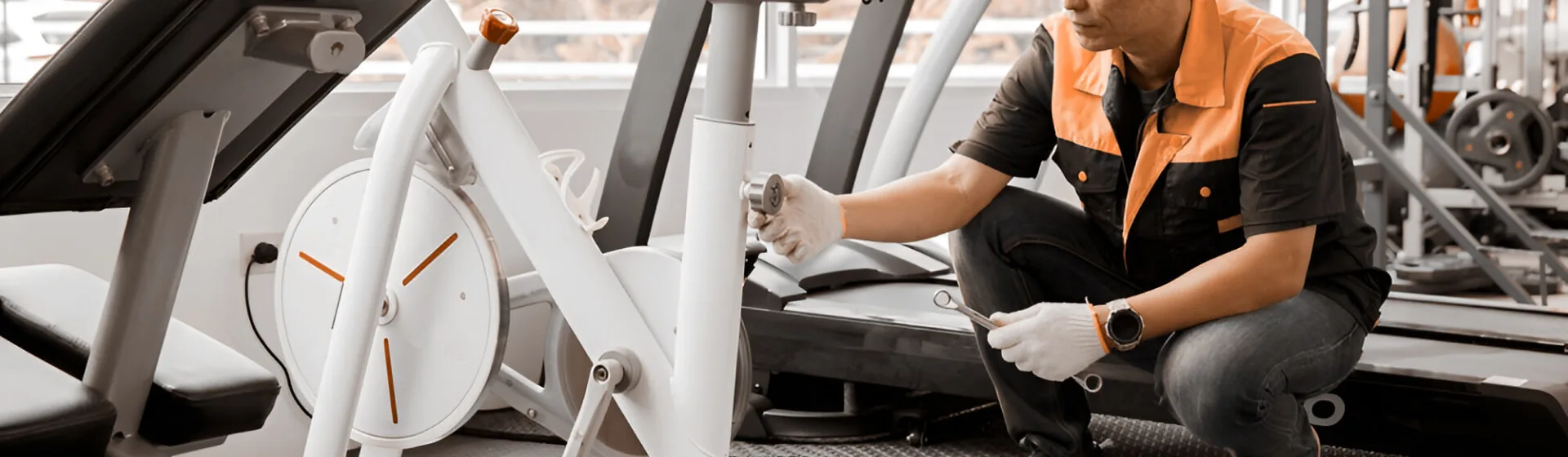
Fitness Equipment We Repair

On Site Fitness Service repairs and maintains commercial and residential fitness equipment on site across Texas, and has done so since 2007 across more than 30,000 service calls in over 300 Texas cities. Each page below covers how that machine type actually fails, what the common symptoms usually mean, and what a preventive maintenance visit checks on it.

On Site Fitness Service across Texas

  • 30,000+service calls completed since 2007
  • 300+Texas cities serviced
  • 10machine types detailed below
  • 25commercial brands serviced

We repair, maintain and install commercial and residential fitness equipment on site across Texas — a single treadmill in an apartment amenity room, a studio of spin bikes, or a whole floor of selectorized strength. Our technicians are factory trained, so manufacturer warranty labor is handled alongside ordinary repairs, and OEM parts are used wherever the manufacturer supplies them.

Cardio and strength equipment fail differently

It is worth knowing which kind of machine you are dealing with, because it changes how much warning you get.

  • Cardio equipment warns you. Treadmills, ellipticals, bikes and steppers wear through belts, bearings, pads and drive components, and almost all of it announces itself first — a squeak, a slipping belt, a notchy stride, resistance that no longer matches the display. Reported at that stage it is usually an adjustment or a single part.
  • Strength equipment does not. A selectorized machine works exactly as well the day before a cable fails as it did a year earlier. There is no console, no noise and no loss of performance to go on. The only thing that surfaces a fraying cable is somebody inspecting it.
  • Stair climbers are the safety case. Chains, cables and springs carry the user’s full body weight, and a cable gives no warning through the display. That is why handrails and cable condition are checked on every visit to this equipment.
  • Spin bikes have a consumable. The friction pad is designed to be used up. Run past its life it scores the flywheel underneath, which turns an inexpensive part into an expensive one — the clearest example on the site of a small item becoming a large bill.

Maintenance rather than repair

Our Platinum plan runs a per-equipment checklist, so what gets inspected depends on the machine — amp draw and deck wear on a treadmill, cables and springs on a stair climber, guide rods and cable tension on strength equipment, pop-pin assemblies and flywheel condition on a spin bike. Each page above lists the checklist for that equipment in full.

Silver, Gold and Platinum differ in how far they go:

  • SilverInspect decks, belts, elevation systems, cables, pulleys, pins and frames for wear; adjust belts; lubricate visible pivot points and guide rods; keypad function tests; calibrate and test every unit for safe operation. No cleaning or waxing at this level.
  • GoldEverything in Silver, plus internal cleaning and vacuuming, treadmill deck waxing and upholstery cleaning — and fuller lubrication covering elevation systems, chains, gears, bushings and seat slides.
  • PlatinumA per-machine checklist by equipment type, adding exterior cleaning — hoods, frames, covers, chrome and flywheels — plus electrical and diagnostic checks: motor brushes, amp draw, error codes and usage hours.

Plans are priced on the number of cardio and strength pieces at the facility, and the interval is set by how hard the room is used rather than by the calendar. See our maintenance programs for the full breakdown, or call 800-730-5802.

Why maintenance matters

Commercial fitness equipment is built to a published standard. ASTM F2276, the standard specification for fitness equipment, sets design and construction requirements for commercial machines and requires manufacturers to supply maintenance instructions alongside assembly and operating documentation. Those instructions are the baseline a maintenance plan is built on, and they are what a manufacturer will point to if a warranty claim is questioned.

Equipment failures are not only a cost problem. The U.S. Consumer Product Safety Commission tracks emergency-department visits involving consumer products, including exercise equipment, through its National Electronic Injury Surveillance System, which is the federal source facilities and insurers reference on this subject. A frayed cable, a slipping belt or a worn deck is a safety issue before it is a repair bill.

Looking for your city or facility type?

See our Texas service areas for city-level detail, or the kinds of facilities we work in.

Fitness Equipment Repair FAQs

What kinds of fitness equipment do you repair?

Treadmills, ellipticals and cross-trainers, spin bikes and indoor cycles, upright and recumbent exercise bikes, stair climbers and steppers, and selectorized and cable strength equipment. Those are the six machine types with their own page here, and they are a sample of what we see most rather than the limit of what we service — if your equipment is not listed, ask.

Do you repair equipment on site, or does it have to be collected?

On site, at your facility. That is the whole model: our technicians bring the work to the machine, so a treadmill or a strength system never has to be moved out of the building. It is why we cover more than 300 Texas cities rather than operating from a single workshop.

Can you fix the machine on the first visit?

Sometimes, but it would be misleading to promise it. Nobody in this industry stocks every part for every model, so the first visit is about identifying the exact part needed so it is ordered once instead of guessed at. Getting a technician out early is what actually shortens the time a machine is out of service.

Do you handle manufacturer warranty repairs?

Yes. Our technicians are factory trained, so warranty labor is billed to the manufacturer rather than to you, and it is handled by the same crew that does ordinary out-of-warranty work. Have the make, model and rough age to hand when you call and we will check what applies.

How is a repair quoted?

Nothing starts without an approved quote for that property. Repairs, warranty work and diagnostics are quoted and billed per property. Preventive maintenance is the exception — it can be priced across a portfolio with a volume discount as more properties come on.

Is a maintenance plan worth it, or should we just call when something breaks?

It depends on the machine. Cardio equipment usually warns you through noise or feel, so reactive repair loses less. Strength equipment gives no warning at all before a cable fails, and stair climber cables and springs carry a user's full body weight, so those are the strongest cases for scheduled inspection. Each equipment page sets out what a visit checks on that machine.