
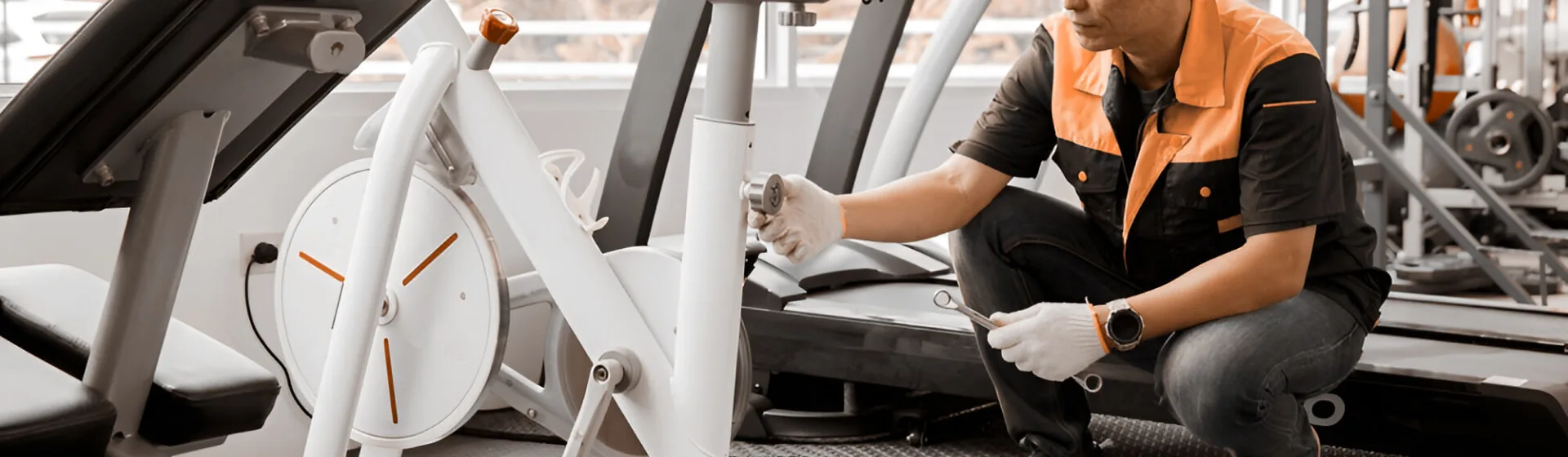
Air Bike and Fan Bike Repair

On Site Fitness Service repairs air bikes and fan bikes on site across Texas, part of more than 30,000 service calls completed since 2007 in over 300 Texas cities. Fan drives, belts and chains, arm linkages, pedals and bearings are handled at your facility.

What goes wrong with air bikes and fan bikes

Air bikes take more abuse than any other cardio machine in a facility. They are used almost exclusively for intervals, at maximum effort, by people driving with both arms and both legs at once, and the resistance rises with effort so the harder they are ridden the more load goes through the frame. Equipment that is fine in a hotel fitness room gets destroyed in a CrossFit-style class, and that is a usage difference rather than a quality one.

The drive is the first thing to go. Belt-driven bikes need tension checked and belts replaced as they stretch; chain-driven bikes need the chain cleaned, lubricated and tensioned. A slipping drive on an air bike feels like the resistance has vanished mid-effort, which is both a complaint and a way for somebody to hurt themselves.

After that it is the joints. Arm linkages, pedal cranks and the bearings they turn on take reversing load thousands of times a session, so play develops early and gets worse quickly once it starts. The fan housing itself rarely fails but fills with dust that unbalances it, and the pedals — usually the cheapest part on the machine — are the ones that actually strand a bike, because a stripped pedal thread takes the crank with it if it is ridden.

What you are seeing, and what it usually means

These are the reports we get most often on this equipment and the fault each one normally points at. None of them is a diagnosis on its own — the machine still has to be looked at — but they are a reasonable guide to whether something needs attention now.

  • Resistance vanishes or slips mid-effort — a stretched drive belt or a loose chain — a hazard at interval intensity, not just a fault
  • Knocking or play through the arms at the top of the stroke — worn linkage bearings or bushings, which get worse quickly once play starts
  • A wobble or vibration from the fan at speed — dust build-up unbalancing the fan, or a worn main bearing
  • The pedal feels loose or has started to click — a pedal thread beginning to strip — stop using it, a ridden-loose pedal ruins the crank arm
  • Squealing or rumbling that rises with effort — a dry chain, or bearings in the drive that have lost lubrication
  • The console is blank — battery first on these machines, then the sensor and its connection

Brands we service

We service the air and fan bikes common in Texas facilities, including Life Fitness, Precor, Spirit Fitness and Body Solid, along with the dedicated interval brands. That is a sample of what comes through rather than the limit of what we service, so ask about anything not named here.

On Site Fitness Service has worked across Texas since 2007 and has completed more than 30,000 service calls in over 300 Texas cities. Our technicians are factory trained, so manufacturer warranty labor is handled alongside ordinary out-of-warranty repairs, and OEM parts are used wherever the manufacturer supplies them.

What a preventive maintenance visit covers on air bikes and fan bikes

Interval equipment needs checking on hours ridden rather than on the calendar. An air bike in a class-based facility can take more load in a month than the same bike takes in a year in a corporate wellness room, and the parts that fail on it — belts, chains, linkage bearings, pedal threads — are all cheap while they are still the part that is worn.

Our Platinum plan runs a per-equipment checklist — 9 separate checks on air bikes and fan bikes, every visit:

Air bikes are not one of the five groups broken out on our /maintenance/ page, so the list below is the inspection our technicians run on this machine rather than a quote from that published checklist. It is weighted towards the drive and the joints, which is where this equipment actually wears.

  • Inspect and Tension Drive Belt or Chain
  • Lubricate Chain
  • Check Arm Linkage Bearings for Play
  • Check Pedals and Crank Threads
  • Inspect Main Bearing
  • Clean Fan Housing and Blades
  • Check Frame Fasteners and Welds
  • Check Seat Post and Adjustment
  • Check Console and Battery

The three plans differ in how far they go:

  • SilverInspect decks, belts, elevation systems, cables, pulleys, pins and frames for wear; adjust belts; lubricate visible pivot points and guide rods; keypad function tests; calibrate and test every unit for safe operation. No cleaning or waxing at this level.
  • GoldEverything in Silver, plus internal cleaning and vacuuming, treadmill deck waxing and upholstery cleaning — and fuller lubrication covering elevation systems, chains, gears, bushings and seat slides.
  • PlatinumA per-machine checklist by equipment type, adding exterior cleaning — hoods, frames, covers, chrome and flywheels — plus electrical and diagnostic checks: motor brushes, amp draw, error codes and usage hours.

See our maintenance programs for the full breakdown, or call 800-730-5802.

Why maintenance matters

Commercial fitness equipment is built to a published standard. ASTM F2276, the standard specification for fitness equipment, sets design and construction requirements for commercial machines and requires manufacturers to supply maintenance instructions alongside assembly and operating documentation. Those instructions are the baseline a maintenance plan is built on, and they are also what a manufacturer will point to if a warranty claim is questioned.

Equipment failures are not only a cost problem. The U.S. Consumer Product Safety Commission tracks emergency-department visits involving consumer products, including exercise equipment, through its National Electronic Injury Surveillance System, which is the federal source facilities and insurers reference on this subject. A frayed cable, a slipping belt or a worn deck is a safety issue before it is a repair bill.

The same body of standards covers what has to be ON the machine as well as inside it: ASTM F1749-15 (2020) is the specification for signage and labels on fitness equipment and in the facilities that house it. Warning labels rubbed off by years of use are worth replacing for the same reason the machine is worth maintaining, and both are things an inspection picks up.

How to get this repaired

Nothing starts without an approved quote for a trip and diagnostic, and repairs, warranty work and diagnostics are quoted and billed per property. Because nobody in this industry stocks every part for every model, the first visit is about identifying the exact part so it is ordered once rather than guessed at.

The trip and diagnostic is quoted and billed like any other visit. On some jobs we also offer to credit that trip charge back if you choose to repair or move forward with the quote — it is worth asking when you request one. Where we offer it, it is written into that quote, which is what governs it.

We are usually out to you within 48 to 72 hours. Parts typically arrive in 5 to 7 business days, and then you go back on the schedule for the install — so figure on about 2 weeks end to end for a repair that needs a part, and less where it does not. There is no travel charge inside the Dallas-Fort Worth, Austin, Houston and San Antonio metros; outside those a travel charge applies and is stated in the quote.

Call 800-730-5802 or request a quote. See our Texas service areas for local coverage, or the kinds of facilities we work in.

Air Bike Repair FAQs

Our air bike loses resistance halfway through an interval. What is that?

Almost always the drive — a belt that has stretched or a chain that has gone slack. It is worth treating as urgent rather than routine, because resistance disappearing mid-effort at interval intensity is how somebody gets hurt, not just an inconvenience.

Why do air bikes wear out faster than our other cardio equipment?

Usage, not quality. Air bikes are ridden at maximum effort in intervals, with arms and legs driving at once, and the resistance rises with effort so the hardest riders load the machine the most. The same bike in a corporate wellness room can last for years while one in a class-based facility needs attention several times as often.

A pedal has gone loose. Can we keep using the bike until the visit?

No — take it out of service. A loose pedal is usually a thread starting to strip, and a pedal ridden loose destroys the crank arm it screws into. The pedal is one of the cheapest parts on the machine; the crank is not, and stopping straight away is the difference between the two.

Do you service both chain-driven and belt-driven air bikes?

Yes. Chain bikes need cleaning, lubrication and tensioning; belt bikes need tension checked and belts replaced as they stretch. Both are on the checklist we run for this equipment, along with the linkage bearings and pedal threads that are common to either.

How often should air bikes be serviced in a class-based gym?

More often than the rest of the room, and we set the interval from hours ridden rather than from the calendar. Tell us roughly how many classes a week run on them and we will pitch the schedule to that, since a bike used for intervals every day is a different machine from the same model in an amenity room.