
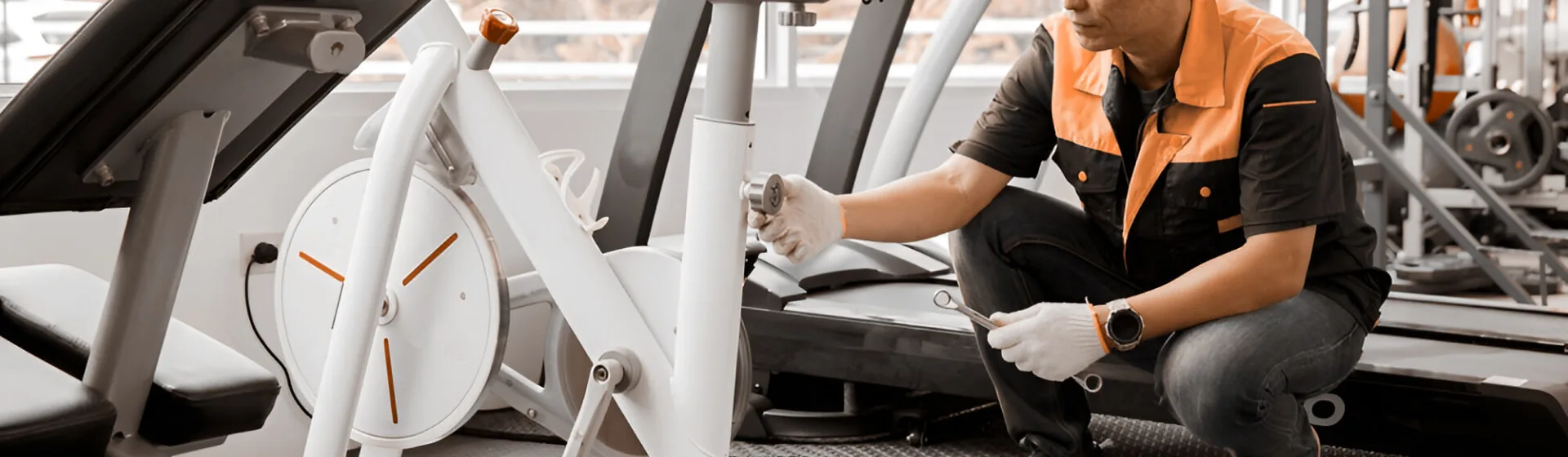
Upper Body Ergometer and Seated Hand Crank Repair

On Site Fitness Service repairs upper body ergometers on site across Texas, part of more than 30,000 service calls completed since 2007 in over 300 Texas cities. Crank assemblies, spindle bearings, height and angle adjustment, resistance and consoles are handled at your facility rather than in a workshop.

What goes wrong with upper body ergometers

An upper body ergometer — a UBE, or in plain language a seated hand crank machine — is worked with the arms only. There are no pedals. Most are used either from a wheelchair rolled up to the machine or from a fixed chair, which makes them the piece of cardio equipment a room can offer somebody who cannot use a treadmill or a bike at all. That is why they turn up in rehabilitation rooms, therapy clinics, senior-living communities and accessible fitness spaces rather than in general gyms.

Because the machine is driven entirely through one assembly, the crank is where nearly everything goes wrong. The spindle bearings carry the whole load and develop play as they dry out; the height and angle adjustment gets moved constantly, by every user rather than once per session, and its lock is the part that wears first. Neither failure stops the machine, which is the problem — a UBE with a worn crank keeps turning and simply gets rougher until somebody stops using it.

Access is the other half of the job and it is easy to miss. A UBE only works if a wheelchair can actually reach it, so the clearance around the frame, the stability of the machine when it is loaded from the front, and the condition of the hand grips and any wrist straps are all part of the inspection. A machine that has drifted six inches against a wall during cleaning is out of service for its intended user even though nothing on it is broken.

Resistance on this equipment is usually magnetic and drifts out of calibration rather than failing outright, and the consoles matter more than on most machines because the numbers are frequently being recorded by a therapist rather than glanced at. A display reading wrong is a real fault here, not a cosmetic one.

What you are seeing, and what it usually means

These are the reports we get most often on this equipment and the fault each one normally points at. None of them is a diagnosis on its own — the machine still has to be looked at — but they are a reasonable guide to whether something needs attention now.

  • Knocking, grinding or play felt through the hand cranks — worn spindle bearings in the crank assembly — the load path for the whole machine
  • The crank height or angle will not hold its setting — the adjustment lock or its detent, worn by being moved every session rather than occasionally
  • Resistance no longer matches the level on the display — magnetic resistance calibration, or a worn resistance assembly
  • The console reads erratically or will not hold a program — a pickup sensor or connection, or the battery on units that carry one
  • A hand grip is worn, loose or missing its wrist strap — grip or strap replacement — an access item on equipment used by people with limited grip strength
  • The machine shifts or rocks when it is worked hard — frame fasteners or leveling feet, which matters more here because load comes from the front rather than downward

Brands we service

SciFit is the line we see most on this equipment, alongside SportsArt, Life Fitness and Precor accessible cardio. That is a sample of what comes through, not the limit of what we service.

On Site Fitness Service has worked across Texas since 2007 and has completed more than 30,000 service calls in over 300 Texas cities. Our technicians are factory trained, so manufacturer warranty labor is handled alongside ordinary out-of-warranty repairs, and OEM parts are used wherever the manufacturer supplies them.

What a preventive maintenance visit covers on upper body ergometers

A UBE fails quietly. Worn crank bearings and a slipping height adjustment both leave a machine that still turns, so nobody reports them — the equipment simply stops being chosen. In a rehabilitation or senior-living room that is worse than an obvious breakdown, because the machine looks available while the residents who need it most have given up on it.

Our Platinum plan runs a per-equipment checklist — 9 separate checks on upper body ergometers, every visit:

This equipment is not one of the five groups broken out on our /maintenance/ page, so the list below is the inspection our technicians run on it rather than a quote from that published checklist. It leads on the crank assembly and on wheelchair access, neither of which appears on a general cardio checklist.

  • Check Crank Assembly and Bearings for Play
  • Lubricate Crank Spindle
  • Check Crank Height and Angle Adjustment
  • Inspect Hand Grips and Wrist Straps
  • Check for Proper Resistance Levels
  • Check Electrical Connections
  • Check Console and Battery
  • Check Frame Fasteners and Leveling
  • Confirm Wheelchair Access Clearance

The three plans differ in how far they go:

  • SilverInspect decks, belts, elevation systems, cables, pulleys, pins and frames for wear; adjust belts; lubricate visible pivot points and guide rods; keypad function tests; calibrate and test every unit for safe operation. No cleaning or waxing at this level.
  • GoldEverything in Silver, plus internal cleaning and vacuuming, treadmill deck waxing and upholstery cleaning — and fuller lubrication covering elevation systems, chains, gears, bushings and seat slides.
  • PlatinumA per-machine checklist by equipment type, adding exterior cleaning — hoods, frames, covers, chrome and flywheels — plus electrical and diagnostic checks: motor brushes, amp draw, error codes and usage hours.

See our maintenance programs for the full breakdown, or call 800-730-5802.

Why maintenance matters

Commercial fitness equipment is built to a published standard. ASTM F2276, the standard specification for fitness equipment, sets design and construction requirements for commercial machines and requires manufacturers to supply maintenance instructions alongside assembly and operating documentation. Those instructions are the baseline a maintenance plan is built on, and they are also what a manufacturer will point to if a warranty claim is questioned.

Equipment failures are not only a cost problem. The U.S. Consumer Product Safety Commission tracks emergency-department visits involving consumer products, including exercise equipment, through its National Electronic Injury Surveillance System, which is the federal source facilities and insurers reference on this subject. A frayed cable, a slipping belt or a worn deck is a safety issue before it is a repair bill.

The same body of standards covers what has to be ON the machine as well as inside it: ASTM F1749-15 (2020) is the specification for signage and labels on fitness equipment and in the facilities that house it. Warning labels rubbed off by years of use are worth replacing for the same reason the machine is worth maintaining, and both are things an inspection picks up.

How to get this repaired

Nothing starts without an approved quote for a trip and diagnostic, and repairs, warranty work and diagnostics are quoted and billed per property. Because nobody in this industry stocks every part for every model, the first visit is about identifying the exact part so it is ordered once rather than guessed at.

The trip and diagnostic is quoted and billed like any other visit. On some jobs we also offer to credit that trip charge back if you choose to repair or move forward with the quote — it is worth asking when you request one. Where we offer it, it is written into that quote, which is what governs it.

We are usually out to you within 48 to 72 hours. Parts typically arrive in 5 to 7 business days, and then you go back on the schedule for the install — so figure on about 2 weeks end to end for a repair that needs a part, and less where it does not. There is no travel charge inside the Dallas-Fort Worth, Austin, Houston and San Antonio metros; outside those a travel charge applies and is stated in the quote.

Call 800-730-5802 or request a quote. See our Texas service areas for local coverage, or the kinds of facilities we work in.

Upper Body Ergometer Repair FAQs

What is an upper body ergometer?

A seated hand crank machine — cranks turned by the arms, with no pedals. It is normally used from a wheelchair rolled up to the machine or from a fixed chair, which makes it the cardio option for somebody who cannot use a treadmill or a bike. It is commonly shortened to UBE. It is not the same thing as an <a href="/equipment/air-bike-repair/">air bike</a>, which is a fan bike with both pedals and moving handles.

Do you service upper body ergometers separately from other equipment?

They get their own inspection, but not a separate visit. The checklist is genuinely different — crank bearings, the height and angle adjustment, hand grips and wheelchair clearance rather than belts and decks — while the visit itself covers everything in the room. A facility with UBEs, recumbent steppers and treadmills is one job.

The cranks feel rough but the machine still works. Is that worth a call?

Yes, and earlier is cheaper. Rough cranks are almost always spindle bearings starting to go, and a bearing replaced on time is a small job. Left alone it loads the crank assembly abnormally and takes more of the machine with it. It is also the point at which residents quietly stop choosing that machine.

Our therapy program depends on the console numbers being right. Can resistance be recalibrated?

Yes, and it is worth asking for specifically. Magnetic resistance drifts rather than fails, so a machine can feel fine while no longer matching its own display. Where the numbers are being followed by a therapist or recorded against a program, that is a real fault, and checking resistance against the display is on our checklist for this equipment.

Is this equipment covered by the same maintenance plans?

Yes. Silver, Gold and Platinum apply exactly as they do to any other equipment, priced on the number of cardio and strength pieces at the facility. What differs is the checklist we run, which leads on the crank assembly and on access rather than on belts and decks.