
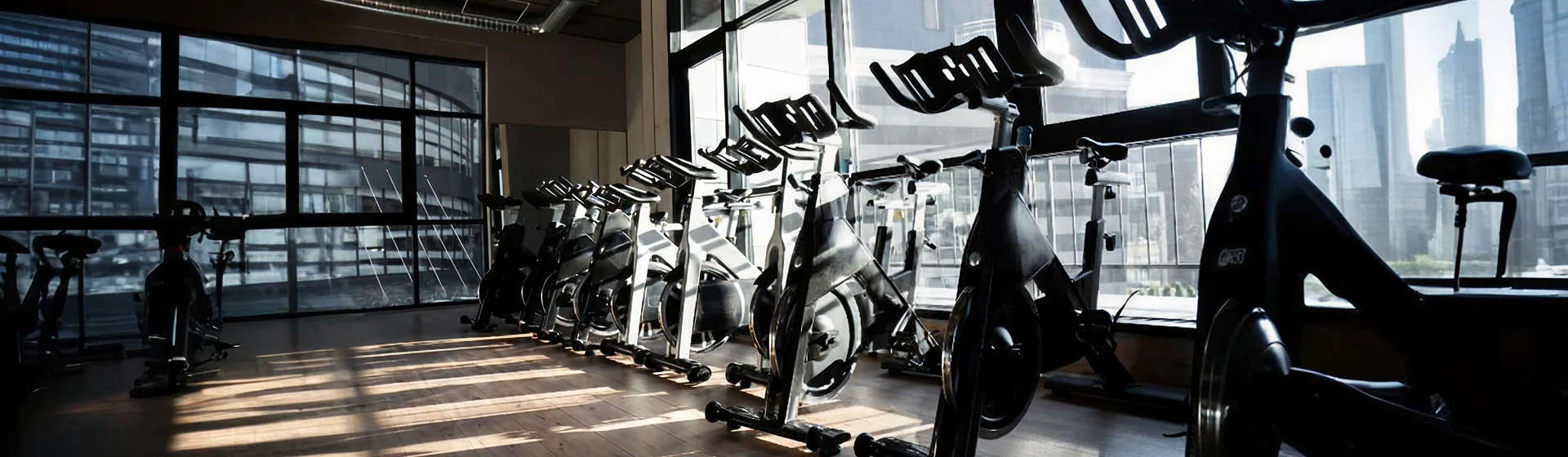
Row of indoor cycling bikes facing floor-to-ceiling windows

Cardiac Rehab and Hospital Fitness Equipment Repair

On Site Fitness Service repairs and maintains the exercise equipment in Texas hospital cardiac and pulmonary rehab rooms and medical fitness centers, part of more than 30,000 service calls completed since 2007. Visits are booked through your facilities team, carried out under the hospital’s own access and infection-control rules, and recorded machine by machine.

What this work usually looks like

A cardiac rehab room runs to a timetable. Medicare’s rule for the program, 42 CFR 410.49, describes physician-prescribed exercise limited to two one-hour sessions a day, and patients are booked into those sessions in advance on treadmills, recumbent cross trainers, recumbent bikes and upper body ergometers. A machine out of service is not an inconvenience in that room: it is a session that has to be rearranged, which is why the equipment is worth looking after on a schedule rather than when it stops.

The treadmill items that matter most here are the ones a patient relies on without thinking about them: the emergency stop and its safety key, the full-length handrails, and a belt that starts smoothly at a slow walking pace. Where a program sets speed and grade for each patient, a treadmill whose speed or incline no longer matches its display is a fault even though it runs. On the seated equipment, the seat carriages, swivels and locks used for every transfer wear first, and magnetic resistance drifts rather than failing, so a recumbent cross trainer can feel normal while reading the wrong level. Every maintenance visit, at every tier, calibrates and tests each unit for safe operation.

A hospital medical fitness center is a different room with the same owner. It runs a full commercial cardio and strength floor for members, usually alongside the same seated cardio a rehab room uses, and its equipment sees health-club hours and loads. We service it as we would a club floor and document it as we would a clinic, under one plan if the hospital wants both rooms covered together.

Working inside an occupied hospital

A hospital sets the terms of entry, and the visit is planned around them. Tell us what yours are when you request the quote:

  • Scheduling. Visits are booked through your facilities, plant operations or clinical engineering team and timed to the quiet part of the program’s day.
  • Badges and check-in. Our technician checks in where you direct, wears the badge your hospital issues and works only in the areas the visit needs.
  • Infection-control rules. Whatever your infection prevention team requires of contractors in a patient-care area — hand hygiene, protective equipment, where tools and parts may be set down, how the work area is cleaned afterwards — applies to the visit.
  • Vendor credentialing. If your hospital requires more before a vendor can enter, such as immunization records or registration with a credentialing service, raise it at the quote stage so it is settled before the visit is booked.
  • The room stays open. Machines are taken out of service as they are worked on and returned when they are done, so a plan visit does not close the program.

Service records for each machine

Hospitals keep a service history on their equipment, and exercise equipment in a clinical program belongs in it. A machine-by-machine report is provided at every maintenance tier: each unit is identified by make and model, with its serial number where it is on record, alongside the visit date, the technician, the checks carried out and what was found. Anything that needs a part comes back as its own quote, which also gives purchasing the document it needs to raise an order before work starts.

File each report against the asset in your own system. Where a machine is labeled by its manufacturer as a medical device, a dated record per unit is the documentation that question calls for; where it is not, the record still answers the question asked after any incident — was this machine inspected, and is there anything in writing to show it.

Repairs, parts and warranty

Expect the first visit to diagnose rather than to finish the job. We are usually out within 48 to 72 hours to find the fault and identify the exact part; nobody in this industry stocks parts for every machine, so most repairs need a second visit once the part arrives, normally in 5 to 7 business days. Nothing starts without an approved quote for that facility.

On warranty, we are an authorized service center for a number of manufacturers — Spirit Fitness, Johnson Health Tech (Matrix) and Core Health & Fitness (Star Trac, Nautilus and StairMaster) among them — and on those brands covered labor and travel are billed to the manufacturer. On any other brand, NuStep and SciFit included, we find out what the manufacturer covers before quoting. A health system with several sites can have preventive maintenance priced across all of them, with a volume discount; repairs stay quoted per facility.

Equipment and brands we service

Cardiac and pulmonary rehab rooms run on treadmills with slow start speeds and full-length handrails, recumbent cross trainers and steppers from NuStep, SciFit and Spirit’s rehab line, recumbent bikes and upper body ergometers, with cable columns and light selectorized strength for the resistance work. Medical fitness centers add a full commercial floor. Machine pages: treadmill repair, recumbent stepper repair, exercise bike repair, upper body ergometer repair and weight machine repair.

On Site Fitness Service has worked across Texas since 2007 and has completed more than 30,000 service calls in over 300 Texas cities. Our technicians are factory trained, so warranty labor is handled alongside ordinary repairs. Brands include StairMaster, Star Trac, Nautilus, Cybex, Technogym, Woodway, Octane, True Fitness, Hoist Fitness, FreeMotion, Inflight Fitness, Vision Fitness, Spirit Fitness, Concept2, Body Solid, Batca, SportsArt, SciFit, Icon, Echelon, Precor, Life Fitness, Matrix, Johnson Health Tech and Core Health & Fitness, among many others — this is a sample of the lines we see most, not the limit of what we service, so ask about anything not named here.

Preventive maintenance for hospital cardiac rehab and medical fitness

A rehab room’s equipment is used every weekday, often by patients who will not mention a fault, which is the case for a scheduled plan in one sentence. Quarterly suits most hospital rooms; a heavily used medical fitness floor may need monthly. Plans are priced on the number of cardio and strength pieces, and for a room that has never had a maintenance visit a one-time PM — the full visit plus a repair quote for anything found — is the usual place to start.

  • SilverInspect decks, belts, elevation systems, cables, pulleys, pins and frames for wear; adjust belts; lubricate visible pivot points and guide rods; keypad function tests; calibrate and test every unit for safe operation. No cleaning or waxing at this level.
  • GoldEverything in Silver, plus internal cleaning and vacuuming, treadmill deck waxing and upholstery cleaning — and fuller lubrication covering elevation systems, chains, gears, bushings and seat slides.
  • PlatinumA per-machine checklist by equipment type, adding exterior cleaning — hoods, frames, covers, chrome and flywheels — plus electrical and diagnostic checks: motor brushes, amp draw, error codes and usage hours.

See our maintenance programs or call 800-730-5802. Torn or tired pads can be recovered and reinstalled rather than replaced.

Why maintenance matters

Commercial fitness equipment is built to a published standard. ASTM F2276, the standard specification for fitness equipment, sets design and construction requirements for commercial machines and requires manufacturers to supply maintenance instructions alongside assembly and operating documentation. Those instructions are the baseline a maintenance plan is built on, and they are also what a manufacturer will point to if a warranty claim is questioned.

Equipment failures are not only a cost problem. The U.S. Consumer Product Safety Commission tracks emergency-department visits involving consumer products, including exercise equipment, through its National Electronic Injury Surveillance System, which is the federal source facilities and insurers reference on this subject. A frayed cable, a slipping belt or a worn deck is a safety issue before it is a repair bill.

Some rehab equipment is a medical device and some is not, and the machine alone does not tell you which: FDA classifies powered exercise equipment intended for medical purposes as Class I under 21 CFR 890.5380, and whether a given unit is one depends on how its manufacturer labels it. For servicing, FDA’s own definition is the useful one: repair or maintenance that returns a device to its safety and performance specifications and its original intended use. That is the job on every machine we work on, labeled as a device or not. The life-saving equipment a pulmonary rehab setting must have under 42 CFR 410.47 — oxygen, resuscitation equipment, a defibrillator — belongs to your clinical engineering team and its vendors; we service the exercise equipment beside it.

That is the practical case for a scheduled plan over reactive repair: it follows the manufacturer’s own maintenance schedule, it produces a written record of what was inspected and when, and it catches wear while it is still an adjustment rather than a replacement.

Where we do this work

We service hospital cardiac rehab and medical fitness across Texas, most heavily in the four big metros: gym equipment repair in Dallas-Fort Worth, Houston, Austin and San Antonio, with no travel charge inside any of them, and well beyond them too. See our Texas service areas for local detail, or call 800-730-5802.

Planning a new program room or replacing equipment? Our sister company Fit Supply supplies, designs and installs cardiac rehab equipment and medical fitness centers, and we service what it installs as well as what you already have. Outpatient clinics have their own page: physical therapy equipment repair.

Hospital Cardiac Rehab and Medical Fitness FAQs

Do you service the treadmills and recumbent cross trainers in a cardiac rehab room?

Yes. Treadmills, NuStep and SciFit recumbent cross trainers and steppers, Spirit’s rehab line, recumbent bikes, upper body ergometers and strength equipment are all part of what we repair and maintain in Texas hospitals, on one visit and under one plan. Our technicians are factory trained.

How do you work with our hospital’s vendor and infection-control rules?

Tell us what they are when you request the quote and the visit is planned around them. Visits are booked through your facilities or clinical engineering team, our technician checks in and badges as you direct, and the rules you set for contractors in patient-care areas apply. Credentialing that goes further, such as immunization records or a vendor registration service, is worth raising at the quote stage so it is settled before anything is booked.

Is rehab exercise equipment a medical device?

Sometimes. It depends on the manufacturer’s labeling, not on the machine: FDA classifies powered exercise equipment intended for medical purposes as Class I under 21 CFR 890.5380, while the same kind of treadmill sold for general fitness is not regulated as a device. Either way our work is repair and maintenance to the manufacturer’s specification.

Do you service the defibrillator, oxygen or ECG telemetry?

No. Life-saving and monitoring equipment belongs to your clinical engineering or biomedical team and its own vendors. We service the exercise equipment — treadmills, recumbent cross trainers, bikes, upper body ergometers and strength equipment — and leave anything clinical in the room as we found it.

Can visits be scheduled around program sessions?

Yes, and they should be. Tell us when the room is quietest — early, late or between session blocks — and the visit is timed to it. Machines are taken out of service as they are worked on, so the program keeps running.

Do we get a service record for each machine?

Yes. A machine-by-machine report is provided at every maintenance tier, not just the top one: make and model, the date and technician, the checks carried out and what was found. It files against the asset in your own system, and it is the record that answers the question asked after an incident.

Do you also service hospital medical fitness centers?

Yes. A medical fitness center runs a full commercial cardio and strength floor with health-club hours, and it is serviced like one: treadmills, ellipticals, bikes, selectorized and plate-loaded strength, functional trainers. Preventive maintenance can cover it and the rehab room under one plan.

Does warranty work cost the hospital anything?

Where the machine is covered and we are an authorized servicer for that brand, the labor and travel are billed to the manufacturer rather than to you. Where we are not, or the fault is not covered, we tell you before doing the work and it is quoted like any other repair — nothing starts without an approved quote.

Need a technician?